
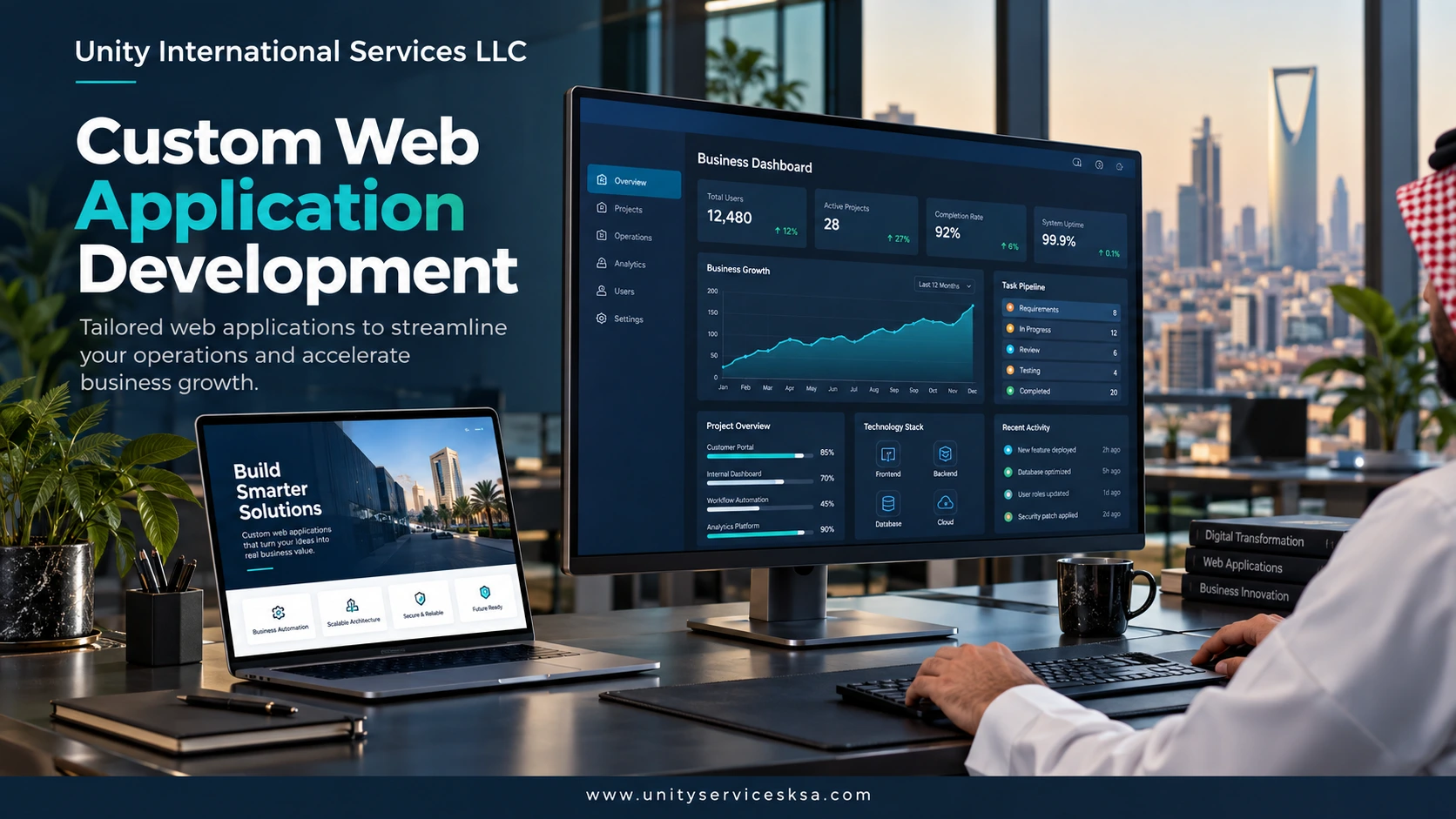
A professional website helps customers understand your business, explore your services and take the next step toward working with you. For an organization investing in its online presence, the quality of website design and development can influence everything from brand perception to enquiry management.
Businesses searching for the best web development company in Saudi Arabia need a partner that can translate their requirements into a practical digital platform. Clear communication, thoughtful design, suitable technology and dependable support all matter.
Unity International Services LLC provides a destination for discussing corporate websites, e-commerce platforms and business website requirements. Its published website categories include corporate websites, landing pages, online shops, booking websites and industry-specific websites. unityservicesksa.com
Whether your company needs its first website or wants to improve an existing platform, a well-defined project can create a stronger foundation for marketing, customer communication and future development.
About Unity International Services LLC
Unity International Services LLC is a Saudi Arabia-based business with website design and development among its listed service areas.
For a website project, the starting point should be the organization’s goals. A company may want to present its capabilities more professionally, generate qualified enquiries, sell products online or provide customers with convenient access to information.
These goals lead to different website structures. A corporate website may emphasize services and completed projects. An online store needs product discovery and purchasing functions. A booking website needs a clear process for selecting and requesting a service.
Discussing these requirements with Unity helps establish the intended scope, content, functionality and support arrangements before development begins.
What Makes a Web Development Company the Best Fit?
The best development company for your business is one that understands your objectives and provides a clear, achievable proposal.
Attractive design is important, but buyers should also examine usability, content management, technical decisions and ownership arrangements. A website must work for customers and remain manageable for the employees responsible for it.
Useful questions include:
- Does the proposed website address our actual business requirements?
- Are the deliverables, exclusions and responsibilities clear?
- Can our employees update routine content?
- How will forms, orders or bookings be tested?
- What happens after the website launches?
- Who controls the domain, hosting and administrative accounts?
These questions provide a practical basis for evaluating Unity’s proposal and comparing it with other options.
Why Consider Unity for Your Website Project?
Unity’s range of published website categories gives businesses a starting point for discussing different digital requirements. The value of any project then depends on how closely its final scope matches the client’s needs.
A Business-Focused Website Brief
A useful project begins by understanding what customers need to find and what actions the company wants them to take.
For example, an engineering company may need visitors to review its capabilities and submit project requirements. A retailer may need customers to browse products and place orders. A professional service provider may prioritize appointment requests.
A focused brief makes design decisions easier and helps avoid unnecessary functionality.
A Structure That Supports Customer Decisions
Customers should be able to understand the business quickly. Clear navigation, informative service pages and visible contact options help them move from initial interest to a meaningful enquiry.
The website should answer essential questions: What does the company provide? Who is it suitable for? What information does the customer need before contacting the team?
A Plan for Future Updates
Businesses change. Services expand, products are introduced and contact information needs updating.
A suitable content management system and clear handover process help the organization maintain its website. Future development should also be considered when selecting the platform and organizing content.
Corporate Website Design and Development
A corporate website represents the company’s identity and provides a structured source of business information.
Depending on the organization, its pages may include company history, services, industries, projects, management information, careers and contact details. Downloadable company profiles and quotation forms may also be useful.
Professional corporate design combines visual consistency with straightforward navigation. Typography, colors, photographs and page layouts should communicate the brand while keeping information readable.
The content should be specific. A service page needs to explain the offering, relevant applications and enquiry process. General statements alone give customers little help when comparing suppliers.
A strong corporate website makes the organization easier to understand and gives visitors a clear route to contact the appropriate team.
E-commerce Website Development
An e-commerce website needs a complete customer journey, from discovering a product to receiving order confirmation.
Planning should cover product categories, search, variations, stock information, customer accounts, delivery arrangements and payment requirements. The required features depend on the business model.
A consumer store may prioritize simple checkout. A B2B website may need quotation requests, detailed specifications or account-based purchasing arrangements.
Payment integration must be assessed against the selected provider’s requirements and technical compatibility. Order administration also deserves careful attention: employees need a practical way to review purchases, update statuses and communicate with customers.
Testing should cover both the storefront and the administrative workflow so the business can operate the website effectively after launch.
Custom Website and Web Application Development
Some businesses need functionality that extends beyond a standard company website.
A custom project may involve customer accounts, dashboards, document access, bookings, approval processes or connections with existing systems. These functions should be defined around an actual workflow.
Consider a service request process. The customer submits information, an employee reviews it, another person approves the response and the customer receives an update. Each stage creates requirements for fields, permissions and notifications.
Mapping the process before development helps identify what the application must do. It also provides a basis for testing.
Custom functionality should be introduced deliberately, with essential features prioritized and additional work planned according to business value.
English and Arabic Website Design
A business serving audiences in English and Arabic should plan both language experiences from the beginning.
Arabic functionality involves appropriate right-to-left layouts, readable typography and natural navigation. Forms, buttons, menus and mobile layouts should be reviewed in both languages.
The content also needs consistency. Customers should receive corresponding service information, contact details and enquiry instructions regardless of their chosen language.
Translation responsibilities should be agreed during planning. The client may supply reviewed translations, or translation and editing may form part of a separately defined service.
A bilingual website is easier to maintain when the organization has a process for updating both versions whenever business information changes.
Responsive Design Across Devices
Customers may visit a website from a smartphone, tablet, laptop or desktop computer. Responsive design adapts the interface to these different screen sizes.
The goal is practical usability. Navigation should remain accessible, text readable and forms comfortable to complete. Images and content blocks should support the page without creating awkward layouts.
Mobile testing should include realistic customer tasks: opening a service page, finding contact information, submitting an enquiry and completing checkout where applicable.
A responsive website also helps employees share links confidently, knowing that customers can access the information from different devices.
Technology Selection for Website Development
Technology should be selected according to project requirements rather than popularity alone.
A content-focused corporate website may suit a familiar CMS. A specialized business application may need a custom framework. An online store requires a platform that supports its product and order workflows.
Examples of technologies that may be evaluated include:
| Technology | Possible role |
|---|---|
| HTML, CSS and JavaScript | Page structure, presentation and browser interactions |
| WordPress | Content-managed business websites |
| WooCommerce | Suitable online stores within WordPress |
| PHP and Laravel | Custom backend functions and business workflows |
| React or Next.js | Interactive interfaces and suitable web applications |
| MySQL or PostgreSQL | Structured application data |
| APIs | Connections with compatible external services |
These examples are not a confirmed Unity technology stack. The project proposal should identify the actual platform, explain its suitability and describe maintenance responsibilities.
UI/UX Design That Helps Visitors Act
User interface design covers the visible elements of a website, including menus, buttons, forms and page components. User experience considers how easily people understand the website and complete their tasks.
Good design starts with information architecture. Services should be grouped logically, page titles should describe their content and contact options should appear where visitors need them.
Calls to action should be specific. “Request a Quotation” provides a clearer direction than a vague instruction when the page is intended to generate sales enquiries.
Forms should collect enough information to support follow-up without becoming unnecessarily difficult to complete.
The result should be a website that feels coherent and helps customers move forward.
SEO-Friendly Website Development
An SEO-friendly website gives important content a clear, accessible structure.
Relevant service pages, descriptive page titles, logical headings and useful internal links help communicate what the business offers. Images should support the content, while essential information should appear as readable page text.
For Saudi-focused businesses, content can explain services, applications and genuine coverage areas. Location references should reflect where the company actually operates or serves customers.
Keyword use should remain natural. The phrase “web development company in Saudi Arabia” belongs where it helps describe the topic, rather than being repeated throughout every paragraph.
Technical development creates a foundation for SEO. Continued content work, monitoring and improvements remain important, and a specific search ranking cannot be guaranteed.
Website Performance and Security
Performance and security should be considered during development and maintained after launch.
Performance work may involve efficient images, appropriate asset delivery, caching and suitable hosting. Testing should examine important pages and customer journeys under representative conditions.
Security requirements depend on the platform and information handled. Common considerations include HTTPS, administrative permissions, secure authentication, software updates and backup arrangements.
For websites with customer accounts or integrations, additional assessment may be needed.
The project scope should explain which measures are included and who maintains them. Clear responsibilities help the organization manage its website over time.
How a Website Development Project Works
A structured process gives clients visibility into progress and creates useful review points.
Step 1 — Requirements: Define the audience, objectives, pages, languages and functions.
Step 2 — Planning: Agree on the sitemap, platform, deliverables, responsibilities and milestones.
Step 3 — Design: Prepare layouts and user journeys for review.
Step 4 — Development: Build the approved interface and agreed functionality.
Step 5 — Content integration: Add reviewed text, images and translations.
Step 6 — Testing: Check navigation, forms, permissions and applicable transactions across representative devices.
Step 7 — Launch and handover: Complete approval, deployment, access transfer and training.
Step 8 — Support: Continue maintenance according to the agreed arrangement.
Timely client feedback and content preparation help keep these stages moving.
Website Maintenance and Technical Support
A website needs attention after publication. Content changes, software updates and technical issues can arise throughout its life.
A support agreement should define included tasks, communication channels, response arrangements and exclusions. It should distinguish routine maintenance from new development.
Depending on the agreement, work may include updates, backups, troubleshooting, content changes and performance reviews.
Ownership also needs clarity. The company should understand who controls the domain, hosting account, website assets and third-party subscriptions.
When discussing support with Unity, explain how important the website is to daily operations. An informational site and an active online store may require different support arrangements.
Website Cost and Delivery Time
The cost of website development depends on design complexity, page count, languages, custom functions, integrations and content requirements.
Delivery time depends on those factors as well as approvals and client inputs. Missing product information or delayed translations can affect the schedule.
A useful quotation request should include the business type, required pages, preferred languages, essential features and existing website address. Include any target launch date and the reason for it.
Compare proposals against the same requirements. Confirm whether content writing, translation, hosting, training and maintenance are included.
An itemized scope makes the investment easier to assess and reduces misunderstandings.
Frequently Asked Questions
Why consider Unity International Services LLC?
Unity lists several website development categories relevant to business projects. Assess suitability through a clear proposal, demonstrations and agreed support terms.
Can I request an English and Arabic website?
Bilingual functionality can be included in the project brief. Layout, translation and review requirements should be defined.
Can an existing website be redesigned?
A redesign can be planned after reviewing its content, functionality, URLs and technical condition.
Can the website connect with other software?
Possible integrations require an assessment of the systems, available interfaces and intended workflow.
Will employees be able to update content?
CMS access and training can be specified according to the pages and functions employees need to manage.
Does development guarantee Google rankings?
No. Search-friendly development supports SEO, but rankings depend on multiple factors and ongoing work.
Discuss Your Project with Unity
A successful website begins with clear requirements and a development plan that fits the business.
Contact Unity International Services LLC to discuss your corporate website, online store or custom web project. Share your objectives and request a proposal covering design, technology, content, testing, handover and support.
Unity International Services LLC
Al Shoqiyah, Makkah, Saudi Arabia
Phone: +966 530651576
Table of Contents